A surface defined by an equation in the form of 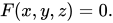
Examples of implicit surface equations:
| Surface | Equation |
|---|---|
| Plane |  |
| Sphere |  |
| Torus |  |
| Surface of genus 2 |  |
| Surface of revolution |  |
Articles:
- Implicit surface on Wikipedia
- Implicit surfaces by Paul Bourke
- Implicit surface a.k.a (signed) distance field: definition by Rodolphe Vaillant
Notable software: